


Alla Romazanova: "We Work Not Only With Skin, But With the Soul"

The artist, tattoo specialist, dermopigmentation expert and founder of Permanent.Academy speaks to PULSE PMU about a profession that has evolved from induction machines to realistic areola work, scar camouflage, trichopigmentation and social restoration after oncology, trauma and surgery.
When Alla Romazanova speaks about permanent makeup, she rarely speaks about it as a way to "make someone beautiful." In her vocabulary, beauty has a deeper meaning: to help a person feel calm in front of a mirror again, to restore a lost sense of the body, to help a woman after mastectomy feel whole, to give someone after trauma the freedom not to explain their appearance to every stranger's gaze.

This is not a casual success story. It is the path of an artist who entered tattooing as a teenager, witnessed the early years of permanent makeup in Minsk, worked through an era of heavy machines and almost no protocols, and eventually found her true professional language where art meets medicine, psychology and human dignity.
PULSE PMU: Alla Romazanova, how did your journey in permanent makeup begin?
I started permanent makeup in 2000, when I began working at the first tattoo studio in Minsk. To be honest, at that time I did not fully understand what permanent makeup was supposed to be. We learned from one another. There was no system of knowledge like the one we have today, no familiar schools, no clear protocols, no vast choice of equipment, pigments or needles.
The first procedures were done with induction machines. They were heavier, rougher, and they vibrated. Doctors were part of the team and handled anesthesia. Today it sounds almost like another profession, but that was the reality of the early 2000s. Everything depended on observation, practice, courage and constant searching.
I did not come from a salon background. I came from tattooing and from the art world. I began tattooing at 15, traveled to international tattoo conventions, saw many artists, many approaches and many different attitudes toward the body. But permanent makeup turned out to be a separate discipline. More delicate, more intimate, more demanding in terms of precision.
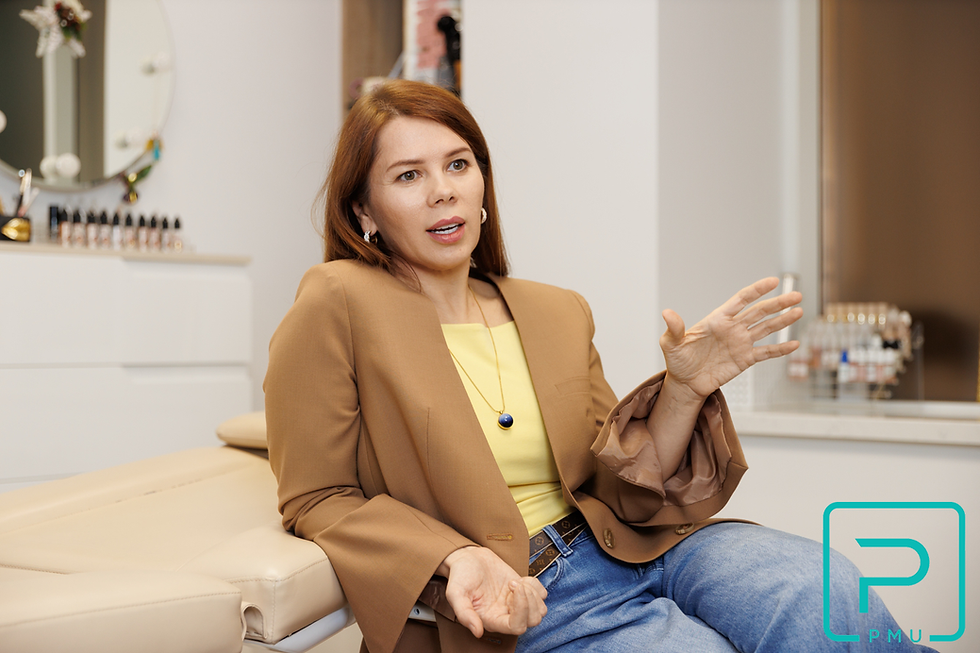
PULSE PMU: You often say that your work is not about changing a person, but about revealing what is already there. Where does this principle come from?
I have 14 years of art education, and that shaped my vision very strongly. An artist first learns to see. Not to impose, not to correct aggressively, not to prove their presence, but to truly see: proportions, character, light, line, volume, individuality.
In permanent makeup I have always followed nature. I believed, and still believe, that permanent makeup should enhance and improve what a person was born with. It should not fight the face. It should not break it. It should not turn a person into a trend. Trends pass, but a person remains with themselves.
Perhaps this approach is exactly what allowed me to stay in the profession until today. When you work against nature, time eventually exposes it. When you work with nature, the result lives longer and looks more honest.
PULSE PMU: The industry has changed radically over the years. What do you see as the main force behind its development?
Equipment changed everything. When the machine became an extension of the hand, when strong vibration disappeared, techniques became more accurate and more predictable. Earlier, artists had to rely on feeling. Today we have much more knowledge and much more responsibility.
The study of skin became extremely important. When the profession developed a deeper understanding of skin layers, healing processes and pigment implantation depth, the work changed completely. We began to understand why pigment can migrate, why color changes, why the same technique gives different results on different skin.
Pigmentology was also a huge step forward. In the past, color was often chosen visually: it looks nice, it suits, it feels beautiful. Now we must understand how it will behave after healing, how it will look in a year, in several years, how it will react on warm or cool skin, on a scar, on altered tissue.
Another important area is removal and lightening. Today, many things have become reversible or correctable. That does not reduce responsibility. It increases it. An artist should work in such a way that the client will not need correction later.
PULSE PMU: You gained international recognition after moving into areola work and camouflage. Why did this direction become yours?
Professional hunger brought me there. At some point, simply doing beautiful procedures was no longer enough. I wanted a deeper, more complex and more honest task. I wanted to be useful not only aesthetically.
Areola work, camouflage, scars, burns and altered skin immediately gave me the feeling that there was a real mission in this field. There is a lot of feminine energy there, a lot of trust, a lot of pain that is not always spoken aloud. A woman after oncology may look strong, organized, smiling, back at work and with her family, but inside she may still carry a feeling of loss. When you restore an areola, you are not simply working with color. You are working with body image.
My tattoo background helped a lot. I had already worked with scars, burns and difficult skin, and I understood that skin does not always behave perfectly. But dermopigmentation carries a different measure of responsibility. You cannot think only as an artist. You must think as a specialist dealing with the consequences of illness, surgery, trauma, and sometimes a very difficult chapter of someone's life.

PULSE PMU: In the beginning, was the hardest part technical or psychological?
The hardest part was finding clients. Today the demand already exists, clients are informed, doctors recommend us, and women after oncology know that this possibility exists. In the beginning, people had to be introduced to the idea itself: that an areola can be visually restored, that a scar can be made less noticeable, that skin after surgery can look softer and more natural.
Technically, this field is also very difficult. But technique can be studied, trained and practiced. Creating trust is much harder. A person must believe that you will not make things worse. In our work, that is the main moral agreement.
PULSE PMU: What do you see in clients after these procedures? What changes?
It happens all the time. An areola may seem invisible to the outside world, but after the procedure many areas of a woman's life begin to tune themselves like a fine musical instrument. Posture changes, the gaze changes, the relationship with the body changes. Women return to relationships, become braver in their personal lives, accept their bodies more easily. Some get married, some finally stop avoiding intimacy, some simply undress in front of a mirror calmly for the first time in a long while.
For me, every such work is a miracle. It is a promise that life can be as it was before. And sometimes even better, because after a difficult experience a person may begin to value themselves differently. I do not want to sound grand, but a small tattoo can truly change life for the better. Especially when it is done at the right moment, by the right hands and with the right attitude.
PULSE PMU: In 2025, a wider audience discovered your work through the story of Pavel, a man who survived a severe accident and lost part of his face. Onliner and Pikabu wrote about it. How do you see that case yourself?

For me, it is not a story about an "eye tattoo." That name simplifies what happened too much. It is a story about a person who went through a very severe trial and still chose to live, to go out into the world, to look forward, not to close himself off.
Pavel experienced enormous trauma. After the accident, burns, surgeries, recovery and nose prosthetics, he faced a choice: to continue along the surgical path or find another solution. When we met, I understood that this was not an ordinary task. I prepared, thought, trained, searched for the form, the volume, the light, the depth. It was not possible to simply draw an eye. It was necessary to create an illusion that would be perceived as alive, while remaining respectful to his face and his story.

I am very glad that this work received a response. But resonance is not the main thing for me. The main thing is that a person gained more freedom. Sometimes our profession gives not only an aesthetic result, but social breathing. A person stops being held hostage by other people's reactions.
PULSE PMU: Why do you avoid romanticizing the reconstructive field? From the outside, it looks deeply inspiring.
Because romanticizing it can be dangerous. We work not only with skin, but also with the soul. We have no right to make things worse.
In this field, honest assessment of the starting condition is crucial. Not every defect is suitable for color work. Not every scar can be beautifully hidden. Not every skin will give the result a person imagines. Sometimes you need to refuse. Sometimes you need to send someone to a doctor. Sometimes you need to explain that it is better to wait.
I see three foundations of good work. First: the starting condition. You must understand what you are working with. Second: technique. The hand must be precise, the movements conscious, the depth controlled. Third: materials. Pigments must give a predictable result, needles must create the required pattern, equipment must be reliable.
Beautiful words do not solve anything here. Discipline does.

PULSE PMU: Today doctors increasingly recommend such procedures, and clients come with more awareness. What does this say about the industry?
It says that this direction is only gaining momentum. The public demand already exists. People understand that after oncology, surgery, trauma, burns, alopecia and scarring, they do not simply have to "accept it." They can find a delicate path toward restoration.
It is very important that doctors begin to see us not simply as beauty artists, but as specialists who can become part of the rehabilitation path. Of course, we do not replace medicine. That is essential. But we can complete an important stage of recovery, when the medical task has already been solved and the person still needs to regain a sense of normality.

The task for artists now is to learn and to become visible. Clients should be able to find their specialist. Not a random one, not simply the loudest person on social media, but someone trained, attentive and honest.
PULSE PMU: Did your educational project Permanent.Academy grow from this understanding of the profession?
Yes. I am a doer and a researcher. It is important for me to study the direction, turn it into a system and pass techniques on to my students. At some point you understand: if you can help people yourself, that is good. But if you can teach others to help correctly, the scale becomes completely different.
Permanent.Academy is not just a permanent makeup school for me. It is a space where an artist learns to think professionally. We speak not only about technique, but also about skin, color, materials, ethics, boundaries of responsibility and communication with the client.
We have online courses that allow students from different countries to study in a structured way. For example, the Realistic Areola online course, the Skin Defects Camouflage online course and the Trichopigmentation online course. There is also a basic offline course for those entering the profession, and offline masterclasses for practicing specialists.

The online format matters because it gives access to knowledge to those who cannot travel immediately. But I always emphasize that even online learning must be practical. Paper, latex, models, assignments, feedback, analysis of mistakes. You cannot learn reconstructive work only with your eyes. You have to train both your hand and your thinking.
PULSE PMU: In your view, what is the difference between a strong artist and a merely popular one?
Industry leaders are those who search for a mission. Those who need something more than financial reward. Money matters, a profession should provide a living, and that is normal. But if there is no meaning behind the work, the artist quickly becomes a hostage of trends.
A strong artist changes not only the client's appearance. They change the person's relationship with themselves. They change their environment, the culture of the profession and the level of responsibility around them. A leader is not the one who speaks the loudest. A leader is the one after whom others want to work more precisely, more honestly and more deeply.
PULSE PMU: If you look at your profession more broadly, what is permanent makeup to you today?
For me, it has long been more than eyebrows, lips or eyeliner. Permanent makeup has become a larger language of restoration. It contains aesthetics, art, craft, psychology, technology, education and a medical context. It can be light and decorative, or it can be very deep, almost invisible, yet life changing.
I like that the industry is maturing. We can no longer work only for the "before and after" effect. We must understand what happens after healing, after a year, after five years. We must be responsible for the trace we leave on a person.
PULSE PMU: What message would you like to share with the international professional community of PULSE PMU?
Together we can do more. This is not a pretty phrase, but the reality of our profession. One artist can change the life of one person. But if the artist passes on knowledge, if students go further, if doctors begin recommending specialists, if clients learn about the possibilities of restoration, then an entire environment changes.
I study this direction and every day I pass techniques on to my students. For me, this is a legacy. Not in the material sense, but in the human sense. We can change lives for the better. Sometimes through very small work. Sometimes through a few millimeters of color. Sometimes through one correctly restored contour. But behind that, there may be an enormous inner transformation.
That is why I remain in the profession.
About Alla Romazanova
Alla Romazanova is an international permanent makeup artist, dermopigmentation specialist, educator, and founder of Permanent.Academy. Her work focuses on areola restoration, scar camouflage, trichopigmentation, and aesthetic rehabilitation following trauma, surgery, and oncology treatment.
Learn more about Alla Romazanova's educational project: Permanent.Academy
#PermanentMakeup #Micropigmentation #Dermopigmentation #MedicalTattooing #AreolaRestoration #ScarCamouflage #VitiligoCamouflage #Trichopigmentation #PMUEducation #PermanentAcademy #AllaRomazanova #InterviewsProfiles
Publication date: June 13, 2026
By Sergey Yakovlev



Comments