


Nereu Matías: Realistic Micropigmentation Begins with Technique but Is Perfected Through Artistic Vision
Naturalness has become one of the primary goals of modern micropigmentation. However, achieving a technically correct result does not necessarily mean creating a truly realistic outcome. The difference lies in the details: the direction of each stroke, its intensity, pigment implantation, color selection, and the artist's ability to adapt the design to each individual's facial anatomy.
Nereu Matías has built his career around the pursuit of natural, personalized results. He is an internationally recognized PMU artist and educator specializing in facial micropigmentation, the founder of Nereu Matias Academy, and is featured on his official channels as a PhiAcademy Grand Master. His professional and educational activities are based in Madrid.
His philosophy extends far beyond mastering a particular technique. Throughout his professional work, he consistently emphasizes the importance of developing sound judgment, confidence, artistic vision, and a comprehensive understanding of the entire micropigmentation process, rather than limiting education to the mechanical execution of a procedure.
In this exclusive interview with PULSE PMU, Nereu Matías shares his perspective on what distinguishes an attractive result from truly realistic micropigmentation, discusses the aspects professionals most often underestimate, and explores the relationship between technique, pigment implantation, and artistic vision.

For readability, this interview has been presented in an edited editorial format while fully preserving the original content, ideas, and intent of Nereu Matías’s responses.
“A Truly Realistic Result Requires Technique, Flow, and Artistic Judgment”
PULSE PMU: Today, many professionals are capable of producing technically correct work, yet not all achieve results that look truly natural. In your opinion, what distinguishes an attractive piece of work from genuinely realistic micropigmentation? What criteria do you use to determine whether a result has reached the highest professional standard?
Creating truly realistic micropigmentation requires evaluating several professional criteria. Some are technical in nature, while others depend directly on the artist’s perception and aesthetic judgment.
First, we must consider the placement and direction of each stroke. Both are essential for creating a sense of flow and ensuring that the design blends naturally with the client's facial features. Individual strokes should never appear isolated; they must relate harmoniously to one another and follow a visually coherent pattern.
Equally important is the control of intensity, as well as the thoughtful use of light and shadow. A realistic result should not have the same visual strength throughout the entire design. Instead, it requires subtle variations that create movement, depth, and a more organic appearance.
For this reason, the quality of micropigmentation cannot be judged solely by technical execution. A procedure may be performed flawlessly from a technical standpoint, yet still fail to achieve the best possible result if it lacks artistic interpretation.
The highest level of professional excellence is achieved when technical skill and artistic judgment work together. It is this combination that creates results that are harmonious, fluid, and truly realistic.

The Difference Between Executing a Technique and Creating a Truly Realistic Result
Nereu Matías highlights an important distinction in professional micropigmentation: while technique forms the foundation of every procedure, it alone does not determine the aesthetic quality of the final result.
In realistic eyebrow work, for example, it is not enough to reproduce a sequence of strokes correctly. The artist must understand how hair growth patterns begin and change, where intensity should be increased or softened, and how to integrate the design without compromising the natural expression of the face.
This perspective explains why two procedures performed using a similar technique can produce completely different outcomes. One may appear clean and visually appealing, while the other conveys depth, movement, and a far more convincing integration with the client's natural anatomy.
“Pigment Implantation Technique Has a Profound Impact on the Final Result”
PULSE PMU: Your work demonstrates exceptional attention to detail—from hair direction and color selection to facial anatomy and overall harmony. In your experience, what is the most underestimated aspect of micropigmentation despite having a significant influence on the final result?
Above all, our goal is to achieve natural-looking results. In my experience, one of the factors that has the greatest impact on that outcome is pigment implantation.
When a professional has mastered proper implantation technique, they are able to make much better use of every design element, including placement, distribution, stroke direction, and the interplay of light and shadow.
This applies equally to microblading, powder brows, and combination techniques. While choosing the appropriate technique is important, the final result depends to a large extent on how the pigment is implanted into the skin.
Well-controlled pigment implantation allows the design to express the artist's vision with greater precision. It helps create the right variations in intensity, maintain clean execution, and achieve a more natural visual effect.
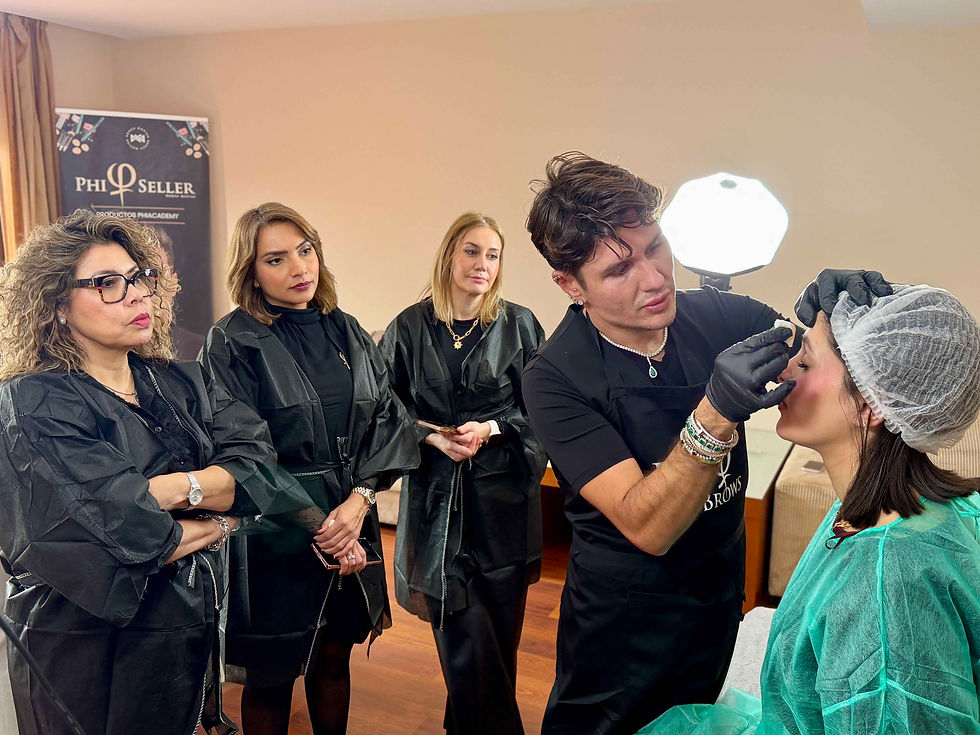
That is why I believe mastering pigment implantation is one of a professional's greatest advantages. It is one of the fundamental elements that transforms an artistic concept into a technically sound and visually harmonious result.
Why Pigment Implantation Should Never Be Treated as a Secondary Detail
In micropigmentation, pigment implantation is the link between visual planning and the way the pigment ultimately behaves in the skin. An artist may have chosen the correct design, color, and stroke direction, but without proper control of the implantation process, that vision cannot be fully translated into the final result.
Nereu Matías does not present pigment implantation as an isolated technique or a universal formula. Instead, he places it within a broader system in which design, intensity, placement, and artistic interpretation of the face all work together.
This perspective challenges a common misconception within the profession: treating technique and aesthetics as separate elements. In reality, they are inseparable. Artistic vision guides every decision, while technical mastery makes it possible to execute those decisions with precision.
Natural-looking results, therefore, are not achieved simply by using fine strokes, soft colors, or a popular technique. They emerge when every element of the procedure serves the same artistic purpose and is carefully adapted to the individual receiving the treatment.
“Education Does Not End with a Course—It Begins When You Develop Your Own Professional Judgment”

PULSE PMU: Throughout your career, you have trained numerous artists. When you compare today's students with those from five or ten years ago, what has changed the most—their level of preparation, their expectations, or the way they perceive this profession?
I believe the most noticeable change lies in their expectations. We now live in a society that expects immediate results, and this mindset is reflected in professional education as well. Many students want to achieve success quickly and expect to become highly skilled professionals after completing just one or several courses.
The reality, however, is quite different. Education is not simply about learning a technique. It is a much broader process that requires time, consistent practice, and personal development.
A course can provide the necessary tools, but true growth depends on a student's ability to develop artistic vision, refine professional judgment, and understand concepts such as proportion, intensity, movement, and harmony.
In the past, there was a greater appreciation for the fact that learning was a gradual process and that every stage contributed to the final outcome. Today, that patience is more difficult to find because many people want to reach, almost immediately, the level that other professionals have achieved only after years of experience.
For that reason, I believe the greatest challenge today is not learning faster, but understanding that excellence takes time. Knowledge can be acquired, but professional maturity is developed only through consistent practice.
Learning a Technique Is Only the Beginning
Nereu Matías's perspective extends far beyond the teaching of micropigmentation itself. It reflects a broader cultural shift affecting many creative professions: the pursuit of immediate results rather than the gradual development of experience.
In an industry where new techniques, trends, and tools are constantly emerging, it is easy to believe that the next course will be enough to make a significant difference. In reality, however, professional growth rarely depends solely on acquiring new knowledge.
Developing sound professional judgment requires observation, practice, critical self-evaluation, and an understanding of why the same technique can produce different results depending on the client's facial features, skin, and the artist's creative approach.
Continuing education remains essential, but it leads to genuine professional growth only when knowledge is transformed into practical experience.
“Learning from Different Methodologies Helps You Build Your Own Professional Identity”
PULSE PMU: The micropigmentation industry has become increasingly competitive. In your opinion, which skills are no longer a competitive advantage, and which have become essential for building a truly respected and successful professional career?
I believe that today it is no longer enough to be trained within a single methodology. A few years ago, it was more common for professionals to build their entire careers within one school or under one educational system. Today, however, the industry is much broader and offers a wide variety of approaches, styles, and interpretations of micropigmentation.
We work with different facial anatomies, different skin types, varying intensity levels, and diverse aesthetic preferences. Understanding that diversity enables professionals to adapt more effectively to each individual client.
That is why I consider it extremely important to learn from different brands, academies, and educators who offer complementary perspectives. Each contributes unique knowledge that helps professionals understand the field from a different point of view.

What truly matters is not copying a single methodology, but learning from many different approaches in order to develop your own professional judgment.
Ultimately, every professional adopts the knowledge they find most valuable and gradually develops a personal identity. It is that identity that truly sets an artist apart in an increasingly competitive industry.
A Competitive Advantage Is No Longer a Technique—It Is a Professional Vision
For many years, mastering a specific technique could provide a significant competitive advantage. Today, however, information spreads much faster, and new procedures are adopted internationally within a very short time.
In this new landscape, competitive advantage is no longer based solely on technical knowledge. Instead, it increasingly depends on a professional's ability to interpret, combine, and adapt that knowledge.
Nereu Matías's perspective reflects this evolution perfectly. Learning from different educators does not mean abandoning your professional identity. On the contrary, it allows you to build it on a broader foundation enriched by multiple experiences.
In practice, artists who establish long-lasting and respected careers tend to share one characteristic: they are familiar with a wide range of methodologies, yet they do not replicate any of them verbatim. Instead, they develop their own language—one that combines technical skill, artistic judgment, and clinical experience.
That professional identity is probably one of the most valuable assets an artist can build—and one of the most difficult to imitate. For that reason, in an industry that is constantly evolving, continuing education is no longer an end in itself, but the path toward developing a unique and distinctive vision of micropigmentation.
“Natural-Looking Results Will Continue to Shape the Future of Micropigmentation”
PULSE PMU: In recent years, we have seen a clear trend toward increasingly natural-looking results. Do you believe this direction is here to stay, or do you think aesthetic preferences will continue to change? How do you envision the ideal state of micropigmentation five years from now?
I believe that the pursuit of natural-looking results will continue to define the future of our profession. Trends may change, just as they do in fashion and every other field related to aesthetics, but the desire to achieve balanced and harmonious outcomes will always remain.
New styles may emerge, and certain procedures may once again become popular. However, our true objective should never be to follow a specific trend. Instead, it should be to understand each client's individual needs and adapt the treatment accordingly.
We will also witness significant technological progress. Devices, pigments, and materials will continue to improve, providing professionals with increasingly precise tools.
Technology alone, however, will never guarantee better results. The real difference will continue to depend on knowledge, experience, and the artist's ability to make the right decisions in every individual case.
The ideal future of micropigmentation is one that combines innovation, safety, and a completely natural appearance while always respecting each client's unique identity.
Technological Progress Will Never Replace the Artist's Professional Judgment
Every new generation of machines, needles, and pigments promises greater precision and improved results. Yet the history of micropigmentation has shown that technological innovation reaches its full potential only when accompanied by professional growth.
Materials evolve, techniques become more refined, and aesthetic trends continue to change, but certain principles remain constant: respect for facial anatomy, an understanding of color, proper pigment implantation, and the ability to design treatments tailored to each individual.
Nereu Matías's philosophy reflects precisely this balance. The future is not simply about adopting new technologies—it is about using them with greater knowledge, experience, and artistic sensitivity.
In a profession where innovation continues to accelerate, experience will remain the factor that transforms technology into natural-looking, long-lasting results.
“We Must Never Stop Learning”
PULSE PMU: If you could pass on just one professional principle to future generations of artists—a rule that should never be compromised—what would it be, and why?
If I had to summarize everything I have learned throughout my career in a single piece of advice, it would be very simple: never stop learning.
Micropigmentation is constantly evolving. New materials, new research, new techniques, and new ways of understanding our profession continue to emerge. The moment we believe we know everything is the moment we stop growing as professionals.
Learning is not limited to attending courses. It also means observing, questioning ourselves, analyzing our own results, and remaining open to new ideas and different ways of working.
Every artist, every training program, and every experience can offer a new perspective that helps us improve.
When we stop learning, we also stop evolving. By contrast, maintaining curiosity and humility allows us to deliver better results for our clients while building a stronger, more sustainable professional career.

Learning as a Professional Philosophy
Nereu Matías's answers consistently reinforce one central idea throughout this interview: excellence is not a destination—it is a continuous process.
He speaks about technique, but also about observation. About education, but equally about experience. About innovation, always guided by professional judgment. Taken together, his reflections present a vision of micropigmentation that combines technical precision, artistic sensitivity, and a lifelong commitment to professional development.
In a profession where trends evolve rapidly, maintaining curiosity becomes just as valuable as technical skill. Every new piece of knowledge expands an artist's ability to understand the skin, interpret facial anatomy, and respond to the unique needs of each client.
Beyond tools and specific techniques, a successful professional career is built on the willingness to keep learning throughout one's entire journey.
Conclusion: Nereu Matías's Vision of Realistic Micropigmentation
This interview with Nereu Matías offers a profound perspective on the evolution of modern micropigmentation. Throughout the conversation, it becomes clear that the most natural-looking results do not depend on a single technique or a passing trend, but on the combination of knowledge, artistic judgment, and technical mastery.
His philosophy places continuing education at the heart of professional growth. Learning new methodologies, understanding facial anatomy, mastering pigment implantation, and developing a unique professional identity are all essential elements that together lead to sustainable, long-term excellence.
In an industry that continues to evolve through technological innovation and ongoing research, true value will always lie in a professional's ability to use these advancements with sensitivity, responsibility, and aesthetic vision.
Micropigmentation will continue to evolve. However, principles such as natural-looking results, respect for the client, continuous improvement, and lifelong learning will remain the foundation upon which the strongest and most respected professional careers are built.
On behalf of PULSE PMU, we sincerely thank Nereu Matías for his time, openness, and generosity in sharing his experience and professional philosophy. We are confident that this conversation will inspire and educate both artists beginning their careers and experienced professionals seeking continued growth.
#Micropigmentation #RealisticMicropigmentation #FacialMicropigmentation #PermanentMakeup #PMU #RealisticBrows #HyperRealisticBrows #Microblading #PowderBrows #PigmentImplantation #EyebrowDesign #PMUEducation #PMUTraining #NereuMatías #NereuMatiasAcademy #PhiAcademy #PMUArtist #PMUInterview #NaturalLookingResults #PULSEPMU
Publication date: July 16, 2026
By Sergey Yakovlev


Comments