


How to Choose a Pigment for Lip Permanent Makeup: Color Selection and Healed Results
Olga Drobot, color theory expert and creator of DROBOT Pigments, explains how to choose the right pigment color for lip permanent makeup and predict the healed result

My name is Olga Drobot. I am an international permanent makeup expert, founder and director of OLGA DROBOT CENTER, educator, and author of professional techniques in the field of permanent makeup. Years of working with pigments, studying their formulations and how they behave in the skin, have become an important part of my professional practice and ultimately led me to create my own line, DROBOT Pigments.

For me, good permanent makeup is not just about achieving a beautiful result immediately after the procedure. It is far more important to understand what the color will look like once healed and how it will behave in the skin over time. That is why, in this article, I want to take a closer look at one of the key questions in lip permanent makeup: how to choose the right pigment to achieve a predictable healed result that meets the client’s expectations.
Lip permanent makeup is always something of a puzzle for the artist
How do you understand exactly what color the client wants? And more importantly, how do you choose a pigment that will produce a healed shade as close as possible to what she expects?
“Natural,” “peach,” “dusty rose,” “coral,” “cherry” — these may seem like straightforward color descriptions. But the way we perceive shades is highly individual. What one client considers a natural lip color may look completely different to another. The same applies to peach, coral, pink, and cherry shades.
We all see and perceive color differently. That is why there is little point in debating with a client about what “dusty rose” or “peach” is actually supposed to look like. The artist’s task is to align their understanding of the desired color with the client’s before the lip permanent makeup procedure begins.
This is why, when selecting a lip pigment, I recommend using pencils that match the shades of the pigments you work with as closely as possible. This allows you to visually discuss the intended color with the client and significantly reduces the risk of interpreting the same shade differently.
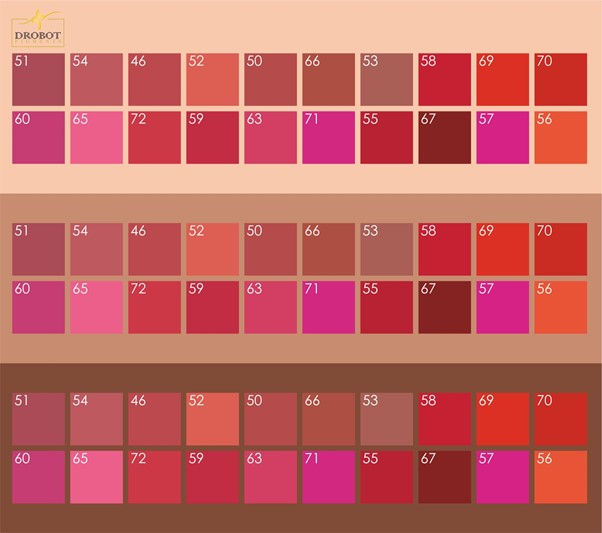
For example, in the DROBOT Pigments line, each pigment shade has a corresponding pencil matched to it in color. This allows both the artist and the client to focus not on a subjective color name, but on a specific visual shade.
DROBOT Pigments color palette for lip permanent makeup. DROBOT Pigments and pencils for previewing and selecting the desired lip shade.
First, we preview and select the desired shade using a pencil to make sure the color is agreed upon with the client. Once the shade has been chosen, we perform the lip permanent makeup procedure using the corresponding pigment color. This approach helps the artist and the client establish a shared understanding of the chosen color before the procedure begins.
Comparison of the selected shade and the healed lip permanent makeup result. Stages of lip permanent makeup: from the initial sketch to the healed result one year later.
Using a pencil, you can select not only the color and shade of the future lip permanent makeup, but also determine the level of color saturation that feels comfortable for the client.
If the pencil is applied more lightly and the client likes the resulting effect, this may indicate that a softer, more transparent watercolor lip technique would suit her. If, however, the result feels too sheer and she prefers a richer, brighter, more “lipstick-like” effect, this should also be taken into account when choosing the technique: the pigment can be implanted more densely or additional passes can be performed.
This way, during the consultation stage, we can agree with the client not only on the shade itself, but also on how saturated she wants the healed result to be.
How to Choose the Ideal Lip Pigment Color
To make lip permanent makeup pigment selection easier, I recommend first dividing all the shades you have into four main categories:
natural;
pink;
red;
berry.
As a rule, these are the general color descriptions clients use when they begin explaining the result they want. So, we first determine the main color direction and then move on to selecting a more specific shade.
Within each category, I recommend further dividing the pigments by undertone:
cool pink;
pink;
red;
orange;
peach;
ginger;
caramel (beige).
This allows us to gradually move from the client’s general idea of the desired color to the specific pigment shade the artist will use.
As a result, you will have a practical lip pigment selection chart that makes it easier to understand the client’s preferences and systematically narrow down a general color description to a specific shade.

When organizing pigments into categories, it is important to remember that the same shade can look completely different on different lips — varying in brightness, saturation, and how natural it appears. Therefore, when selecting a pigment, always consider the client’s natural lip color and individual skin characteristics.
Previewing the color with a pencil allows you to assess the selected shade directly on the client’s lips, taking into account their individual natural lip color as well as the skin tone of the face. This helps you choose a pigment color more accurately, ensuring that it looks harmonious on the individual client and meets her expectations.
Previewing different pencil shades to select the color for lip permanent makeup. Comparison of different shades on the lips for accurate pigment color selection.
If necessary, during a lip permanent makeup touch-up, the pigment shade and saturation can be further adjusted based on the healed result.
Accurate Pigment Selection Is the Foundation of Predictable Results
Choosing a pigment for lip permanent makeup is not simply about selecting an attractive shade from a palette. It is important to understand what color the client herself has in mind, how bright and saturated she wants the result to be, and how the selected shade will work with her natural lip color and skin tone.
That is why I recommend going beyond color names and showing the shade visually using a pencil that corresponds to the selected pigment. This preliminary color preview helps align the artist’s and client’s expectations before the procedure, determine the desired level of saturation, and select the appropriate pigment application technique.
The more accurately we understand the client’s expectations before starting the procedure, the more predictable the healed lip permanent makeup result becomes. And if the shade needs to be slightly adjusted or more saturation is needed after healing, this can be done during the touch-up session.
For me, choosing the right pigment is not primarily about the name of the color, but about understanding the result the client wants to see on her lips once they have healed.
If you would like to learn more about the procedure itself, how it is performed, the healing process, and how the results are maintained over time, we also recommend reading the PULSE PMU article, “What Is Permanent Makeup? A Modern Understanding of the Procedure”
Disclaimer: This article is intended for informational and educational purposes only and reflects the professional experience and views of its author, Olga Drobot. The content does not constitute medical or professional advice and should not replace appropriate training or individual professional assessment. PULSE PMU publishes this material as an independent editorial platform and is not responsible for decisions or outcomes resulting from the application of the information presented.
#PermanentMakeup #LipPermanentMakeup #PMU #LipPMU #PMUArtist #PermanentLips #PermanentMakeupPigments #LipPigments #PMUPigments #PigmentsForPMU #PigmentSelection #LipPigmentSelection #PigmentColor #LipColor #PMUColorTheory #PermanentMakeupColorTheory #HealedPMU #HealedResults #HealedLipPMU #WatercolorLips #WatercolorLipBlush #LipstickEffect #PermanentMakeupArtist #PermanentMakeupTraining #PMUTraining #DROBOTPigments #DROBOT #OlgaDrobot #LipBlush #PULSEPMU
Publication date: August 12, 2026
By Olga Drobot, OLGA DROBOT CENTER


Comments