


Skin as Part of the Story: The Tattoo Culture of Sons of Anarchy
There is a scene in Sons of Anarchy that explains the show’s relationship with tattoos better than any interview could. Former SAMCRO member Kyle Hobart returns to Charming with a large club tattoo on his back. He is no longer a member, but he still carries the club’s symbol. The problem is not a bad choice of tattoo, or even a reminder of the past. Kyle is wearing a symbol he no longer has the right to wear. He is told to remove it — and in the end, the club colors are literally burned off his back.
The scene is brutal even by Sons of Anarchy standards, but it reveals one of the most interesting aspects of the show. Tattoos are almost never just decoration here. They can show belonging, preserve memories, represent a reputation, or tell a character’s story. A leather vest with club patches can be taken off, but a symbol placed on the skin makes that connection far more permanent.

Over seven seasons, Sons of Anarchy created one of the most recognizable images of American outlaw biker culture in modern pop culture. Motorcycles, leather cuts, patches, and tattoos formed such a cohesive visual world that the symbols of the fictional SAMCRO became recognizable far beyond the show’s audience. But this authenticity was no accident: even before filming began, the creators studied real biker culture and brought in a professional tattoo artist to help develop some of the show’s key tattoo designs.
The Club That Stays on Your Skin
Series creator Kurt Sutter has said that while preparing for the show, he spent time in Northern California researching motorcycle club culture. One observation became especially important. He saw a biker whose club symbols covered his entire back: the man could take off his vest and club colors, but his connection to the club was still visible on his skin.
For the world of Sons of Anarchy, it was an almost perfect idea. Club membership needed to feel like more than a hobby or a group of friends — it had to feel like an identity. That is how the famous Grim Reaper came to appear both on the club vests and on the bodies of SAMCRO members.

The name SAMCRO stands for Sons of Anarchy Motorcycle Club, Redwood Original — the club’s original charter in the fictional California town of Charming. That is why the large back piece carries much more meaning than a typical themed tattoo design: a person does not simply wear the club’s colors — he becomes a permanent bearer of them.
This is what gives Kyle’s story in the first season so much meaning. After leaving SAMCRO, returning his vest is not enough. His club tattoo becomes a symbol he no longer has the right to wear. FX even featured the scene in a separate official clip titled Kyle’s Tattoo is Removed. In just a few brutal minutes, the series establishes one of the rules of its world without a long explanation: the image may be on your body, but the club decides who has the right to wear its symbol.
Freddy Corbin: The Man Who Helped Create the Reaper
To make SAMCRO look authentic, the creators needed someone who understood tattoo culture firsthand, not just from reference images. One of the key figures was California tattoo artist Freddy Corbin, founder of Temple Tattoo in Oakland and a well-known figure in the American tattoo scene.

The connection came through executive producer John Linson, who was familiar with Corbin’s work. During the development of the series, Corbin was asked to create sketches for the project. His work helped shape the famous Grim Reaper, which later became the visual emblem of Sons of Anarchy.
The team faced an important challenge: the symbols had to look like they could genuinely belong to an outlaw motorcycle club without copying the emblem of any real organization. That is why the Reaper does not look like a polished television logo. It has the raw character of traditional tattoo art, and the design works just as naturally as a back patch on a vest as it does as a large tattoo.
There is another great detail to the story. Corbin did not remain only behind the scenes: the tattoo artist appeared in the series as Irish Freddy. It brought the story full circle — a real tattoo artist helped create the visual identity of a fictional biker world and then became part of that world himself.
Jax’s Tombstone: The Father He Carries with Him
While the Reaper represents Jax Teller’s connection to SAMCRO, one of his most recognizable personal tattoos is about something very different — memory.
Charlie Hunnam wanted his character to have a memorial tattoo connected to John Teller, Jax’s late father and one of the founders of the Sons of Anarchy. According to Hunnam, the idea was inspired by a tombstone tattoo he had seen on a real biker. Freddy Corbin adapted the concept for Jax, creating a tombstone with John Teller’s name, ravens, and the words “In Memory of Fallen Brothers.”

From a storytelling perspective, this is an incredibly precise detail. John Teller is physically absent from the present-day story, but his ideas, his writings, and the circumstances of his death continue to influence his son. Jax is trying to understand a man he can no longer ask any questions, while also deciding whether the club his father created should remain what it has become.
That is why the tombstone on his arm is more than just a memorial tattoo. Jax literally carries his past on his body.

Hunnam became so used to the design that early in the series he even considered getting it tattooed for real. He eventually decided against it for a practical reason: after Sons of Anarchy, the large tattoo would have to be covered every day for other roles. According to Hunnam, covering it alone could add around twenty minutes to his morning routine on set.
The Same Tattoo, Again and Again
To viewers, Jax’s tattoos simply exist. For the makeup department, they were a continuity challenge.
Because Charlie Hunnam’s key club tattoos were temporary, they had to be recreated regularly in almost exactly the same position. The team used special reference books that documented the boundaries and placement of each design in relation to anatomical landmarks — the wrist, the bend of the elbow, the line of the spine, and even specific moles.

The large back piece was especially challenging. Hunnam had a real tattoo of his own that first had to be covered before the club design could be applied over the prepared skin. Natural marks on the actor’s body were used as reference points to place the design in exactly the right position each time.
These almost invisible details are what make an on-screen tattoo convincing. It is not enough for a tattoo to simply look good on camera — the team also has to consider anatomy, body movement, scale, and continuity over several years of filming. In this sense, the work on Sons of Anarchy reveals an unexpectedly technical side of tattoo design for film and television.
When a Real Tattoo Gets a Fictional Backstory
Throughout the series, tattoos created specifically for the characters appeared alongside the actors’ real tattoos. One of the most interesting examples is David Labrava, who played Happy Lowman.
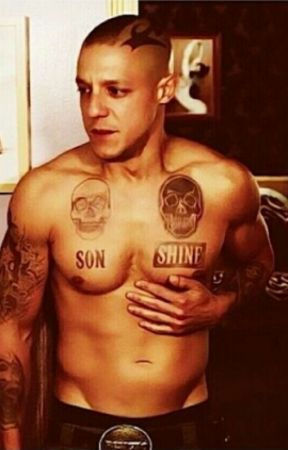
Labrava did not join the project as a traditional Hollywood actor. He initially worked on Sons of Anarchy as a technical consultant, bringing firsthand knowledge of motorcycle culture, and later landed the role of Happy. Some of his real tattoos naturally became part of the character.
The creators went even further, turning an existing visual detail on Labrava’s body into part of Happy’s on-screen story. His small smiley-face tattoos were given a much darker meaning within the series: they are connected to the character’s kills.
This is one of the most interesting techniques used in Sons of Anarchy: instead of creating every detail of a character’s appearance from scratch, the series sometimes built a new story around what was already on the actor’s body. A real tattoo was given a fictional meaning, making the line between actor and character a little less visible.
This is also where it becomes especially important to separate confirmed facts from fan interpretations. Over the years, many explanations have appeared about the “hidden meanings” behind almost every image tattooed on the characters, but not all of them are supported by the creators, actors, or production materials. Sometimes a tattoo really does have a specific meaning written into the story, sometimes it is a real tattoo belonging to the actor, and sometimes its main purpose is simply to shape the character’s visual identity.
More Than a Design: The Right to Wear It
The most interesting part of the tattoo culture in Sons of Anarchy begins when the question “What does this tattoo mean?” gives way to another: Who has the right to wear it?
The series draws on real cultural elements — club colors, patches, memorial tattoos, and symbols of belonging — but transforms them into its own dramatic system. For that reason, SAMCRO’s rules should not be treated as a documentary guide to real motorcycle clubs. They are a fictional interpretation built on real-world observations.
Within the world of the series, however, this system works perfectly. The Reaper represents the club. John Teller’s tombstone carries Jax’s past. The smiley faces become part of Happy’s reputation. And Kyle’s story shows how the same symbol can take on a completely different meaning depending on who is wearing it.
Perhaps that is why the tattoos in Sons of Anarchy still feel convincing years after the series ended. The creators could simply have covered the bikers in skulls, flames, and lettering to achieve the right aesthetic. Instead, they made tattoos part of the character design and the storytelling itself, brought in a real tattoo artist, drew on the firsthand experience of people familiar with motorcycle culture, and allowed the actors’ real tattoos to exist alongside fictional ones.
Skin as Part of the Story | The Tattoo Culture of Sons of Anarchy
Ultimately, Sons of Anarchy is not so much a story about motorcycles and crime as it is about belonging and legacy — what a person inherits from family, the club, and the generation before them, and what they are able to change.
That is why tattoos become one of the show’s most powerful visual symbols. The tattoo culture of Sons of Anarchy is built around this idea: a tattoo may begin as a personal choice, but over time it becomes part of a person’s story. It can preserve the memory of someone long gone or connect its wearer to a community that may one day stop accepting them.
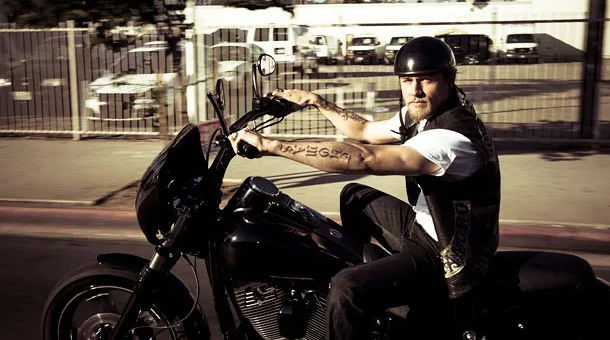
A leather vest can be taken off, a motorcycle can be left behind, and Charming can be left in the past. But Sons of Anarchy returns again and again to a more complex idea: some forms of belonging remain long after a person decides to walk away from them. In the world of SAMCRO, this idea becomes literal — the club’s history is written not only on its colors, but also on the skin.
Tattoo culture extends far beyond television, showing how body art can become a powerful part of identity and visual storytelling. In our PULSE PMU feature “Tattoo Culture in GTA: San Andreas: More Than Just Character Customization,” we explore how tattoos help shape a character’s image and connection to street culture in one of the world’s most famous video games. And for a remarkable real-life example of tattooing as personal expression, discover “Most Tattooed Woman in the World: The Extraordinary Story of Esperance Fuerzina,” whose body art has earned her a place in Guinness World Records.
Copyright Notice: The images used in this article are presented solely for editorial, informational, and illustrative purposes in the context of analyzing the tattoo culture of Sons of Anarchy. All rights to photographs, stills, character images, trademarks, and other protected materials belong to their respective rights holders. PULSE PMU does not claim ownership of any third-party images. If you are a rights holder of any material featured in this article and believe that its use infringes your rights, please contact the PULSE PMU editorial team so that we can review the matter and, where appropriate, provide attribution, replace, or remove the material.
#SonsOfAnarchy #SOA #SAMCRO #JaxTeller #SonsOfAnarchyTattoos #TattooCulture #TattooArt #TattooHistory #TattooDesign #TattooIndustry #TattooArtist #BikerCulture #BikerTattoos #MotorcycleCulture #MotorcycleClub #OutlawBikerCulture #GrimReaper #FreddyCorbin #JaxTellerTattoo #SAMCROTattoo #MemorialTattoo #FilmTattoos #TVTattoos #TattooStories #PULSEPMU
Publication date: August 24, 2026
By Sergey Yakovlev


Comments