


Iren Loseva: “When You Understand the Skin, the Path Becomes Shorter and More Direct”
Introduction
Some artists have professional journeys that cannot be summed up by a single title or a few lines listing their achievements. Iren Loseva is one of them. Her story brings together artistic tattooing and permanent makeup, working with clients and training artists, running her own studio, and years of continuous growth within the industry.
Today, Iren Loseva is the founder and director of Tattoo Style in Mogilev and the founder of the PMU STYLE training center. Her journey of working with skin began with artistic tattooing, with permanent makeup becoming part of her practice later on. It was this experience at the intersection of the two fields that largely shaped her professional perspective: rather than viewing a procedure as a set of mechanically learned movements, she believes in understanding the skin, seeing the composition, and knowing how to approach an image as a unified whole.
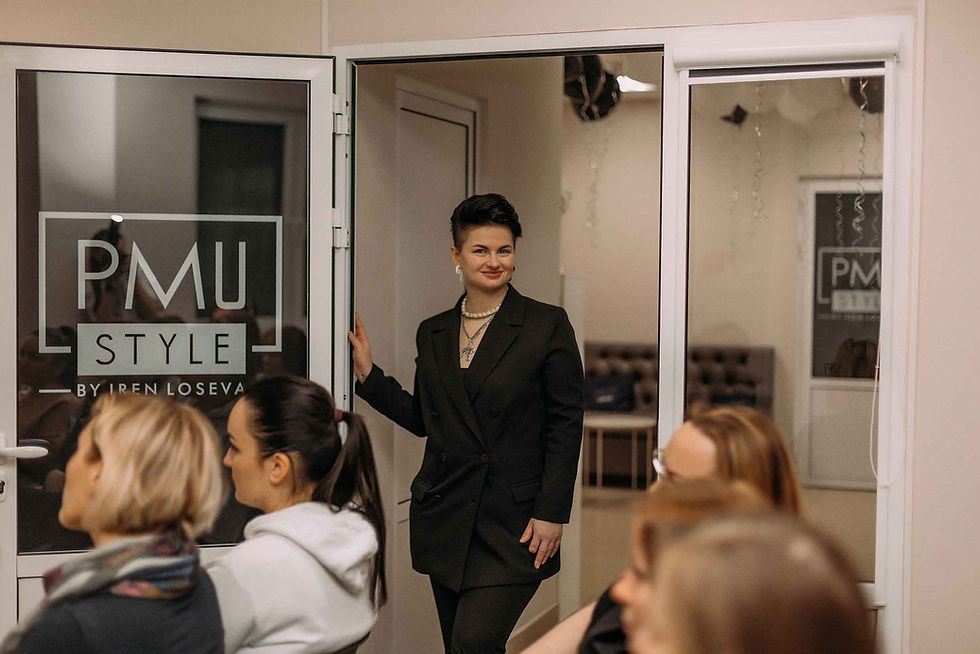
For Iren, permanent makeup has long gone beyond the conventional focus on brows, lips, and eyelids. Her practice includes scalp micropigmentation, scar camouflage, and areola restoration — areas in which an artist’s work can change not only a person’s appearance, but also the way they see themselves.
Loseva’s professional journey gradually led her into education as well. Over the years, she has spoken at professional events, competed in championships, won awards, and served as both a speaker and judge at permanent makeup competitions. At the same time, hands-on work with clients has remained an essential part of her profession — the very foundation without which teaching can easily become nothing more than theory.
With a background like this, it is easy to lose sight of the person behind the achievements. To see a list of championships, titles, and projects — and overlook a far more interesting question: what happens to an artist when a profession becomes the work of several decades of their life? How does their approach to technique, clients, education, and personal development evolve over time? And what remains unchanged as new machines, pigments, techniques, and generations of professionals emerge around them?
This is exactly what PULSE PMU discussed with Iren Loseva — her journey from tattooing to permanent makeup, working with skin and complex cases, “Magnum Magic,” the evolution of the industry, education, and what continues to inspire her after more than two decades in the profession.
PULSE PMU: You came to permanent makeup from artistic tattooing and now have more than 20 years of hands-on experience. How has this background influenced your understanding of skin and your technique in PMU? Are there any skills from traditional tattooing that you believe are particularly valuable for permanent makeup artists to learn?
Yes, that’s right: I came to permanent makeup from artistic tattooing, and to be honest, I still haven’t let it go — it remains what I love doing most. I think it truly is my calling: I dreamed of becoming a tattoo artist from the age of seven, started practicing at 14, and I can hardly imagine my life having turned out any other way — and I’m incredibly happy that it did.
I don’t just believe that studying tattooing is useful for permanent makeup artists — I built my training around this approach from the very beginning. When I first started teaching, we began with tattooing: even if a student had no intention of becoming a tattoo artist, they had to complete at least 10 tattoos on different parts of the body before we moved on to permanent makeup.
Later, in response to requests from artists, I created a separate course called “Mini Tattoo for Permanent Makeup Artists.” It gave professionals the opportunity to learn the fundamentals of tattooing in a more compact format: a masterclass combined with a couple of days of online preparation. This proved very helpful in improving their permanent makeup technique.
What is especially valuable about tattooing is that we work with a wide variety of needle configurations, which leads to a much deeper understanding of the skin — its density, elasticity, complexity, and how it differs across various areas of the body. After working this way, facial skin no longer seems inherently difficult. When you know exactly which needle to choose and which technique to use, you can work much faster without compromising quality. The result becomes faster to achieve, more precise, and more predictable.
It also becomes significantly easier to master camouflage, scalp micropigmentation, scar work, areola restoration, and hairstroke techniques. That doesn’t mean these procedures are impossible to perform without a tattooing background — everything simply becomes clearer, and the path becomes a little shorter and more direct.
PULSE PMU: One of the techniques that has become closely associated with your name is “Magnum Magic.” What initially led you to work so extensively with Magnum needle configurations, and what possibilities did they open up for you in permanent makeup?
I like doing things differently from everyone else. Learning to work with Magnum needles opened up half the world to me. I won championships, including speed categories — for example, “Lips in One Hour.” My first non-stop demonstrations were performed using Magnum needles, and what made me stand out was that… ha-ha… sometimes artists wouldn’t even make it over to watch me before I had already finished. That intrigued people, so they would hurry to see my demonstration first, thinking they would still have time to watch the others afterward.
Later, I sometimes began working on two models during a single demonstration, which made it easier for conference attendees to see the results. At one of the Interstyle events, I performed brows and lips using a Magnum, and then someone challenged me to see how quickly I could do a lash-line enhancement. I wasn’t even rushing, but with the model’s permission, we timed it — and it took six minutes to achieve the final, perfect result… ta-da!
After that, I began receiving invitations from around the world to demonstrate this technique. The name “Magnum Magic” has since been adopted by others, and today many more trainers work with Magnum needles and teach these techniques — and that’s wonderful! I have presented the masterclasses “Magnum Magic,” “Mini Tattoo,” and “Remover: Removing the Unremovable” in the UAE, Turkey, across Europe, Kazakhstan, and, of course, extensively throughout Belarus and Russia.

I was granted a U.S. visa and was also invited to present this topic at a conference in the United States, but unfortunately, it didn’t work out. It was just before COVID: the conference was first postponed and then canceled. So Magnum never made it to America at that time. Fortunately, online education made it possible for anyone interested, from anywhere in the world, to join the training.
PULSE PMU: Your practice extends beyond aesthetic permanent makeup to include scalp micropigmentation, scar camouflage, and areola restoration. How does working with these types of cases fundamentally differ for an artist — both technically and in terms of responsibility to the client?
First and foremost, it is about responsibility. As a rule, if someone is very self-conscious about certain imperfections and they are a source of distress, they will be extremely upset if the procedure leaves them worse off than before.
For example, a poorly executed tattoo over scar tissue is much more difficult to remove because of the nature of the scarred skin. And poorly performed scalp micropigmentation is highly visible and requires constant concealment — even more than if the procedure had never been done at all. Just imagine those frightening photos of a “blue helmet” made up of dots across the scalp — these aren’t horror stories; these are real people and their real lives.
So yes, responsibility comes first, alongside the constant refinement of technique.
PULSE PMU: Over the years, you have witnessed several generations of techniques, equipment, and pigment systems. In your view, what has represented genuine professional progress in PMU, and what has turned out to be more of a passing trend or successful marketing?
Yes, I’ve seen the industry evolve from the days when we soldered needles onto bars ourselves to where we are today. In my view, one of the industry’s major leaps forward came with the arrival of high-quality yet affordable cartridges. When I started, the choice was either cheap and unsafe — Giansan, for example — or astronomically expensive: a machine costing $3,000–$5,000 and individual modules starting at around $10 each. On the other hand, that high barrier to entry did keep completely irresponsible people out of the profession… but that’s another story.
The next major leap was the arrival of high-quality rotary machines that combined power, compact design, and safety. The development of advanced camouflage techniques also took the industry to an entirely new level — they can achieve what no other procedure can, and clients tend to stay with you for life. Camouflage and scar work are also highly promising areas because relatively few artists specialize in them so far. And I believe that remover techniques have also benefited both the industry and its clients.
A passing trend… hmm, sharply defined, heavily accentuated brows. In a sense, everything is temporary — some trends simply stay longer than others. Microblading arrived with a bang and disappeared just as quickly. Very wide brows with an exaggerated multi-level gradient are another trend that is already fading.
Hairstroke techniques have reached an entirely new level, with both pattern design and execution becoming incredibly sophisticated. Another major step forward has been a better understanding of how to work with mineral pigments and a move away from permanent makeup that remains in the skin for many years. We are now seeing a return to semi-permanent pigments. Our brand has developed a brow line based on this concept — mineral semi-permanent pigments, closer to what the term was originally intended to mean, with a more environmentally conscious approach. But apparently, we had to go through some truly disastrous results and years of removals before finding our way back to it.
PULSE PMU: You have been training artists for many years and have developed your own system of online and in-person education. What gaps do you most often see today, even among practicing professionals — in technique, understanding the skin, working with equipment, or professional mindset?
At the beginning — and not only at the beginning — it is primarily about understanding the skin and knowing how to work with equipment. But the further we go, the more mindset-related barriers begin to emerge.
When someone enters permanent makeup — or any related field, whether tattooing, camouflage, removal, it doesn’t really matter — without an entrepreneurial mindset or without allowing themselves to live differently… If they enter the profession out of financial necessity: they had a job, weren’t earning enough, and thought, “Beauty professionals make a ton of money, hallelujah,” so they take their last savings and put everything into installment plans, loans, and so on…
Some people achieve absolutely incredible, mind-blowing results. Others expect that simply being able to say, “I’m an artist,” will automatically allow them to make a fortune and become popular. But that’s not how it works.
There is still a great deal of work to be done on yourself as a person, on the service you provide, and on the overall client experience. It is also about mindset: you have to allow yourself to have more. And even if you are already earning well, the next step in your development is allowing yourself to actually live. Because when you enter the profession primarily because you want to earn more, you often end up allowing yourself nothing but work. You simply start working a lot, earning a lot — and that’s it. But when do you actually get to live?
Today, mindset is what I work with most. For a long time, a business psychologist was involved in all of my major programs — my trainer course, tattoo course, permanent makeup course, essentially all of my comprehensive programs — conducting systemic constellation sessions, practical exercises, and consultations.
Now I have completed additional training myself: I have a qualification in coaching, I’m currently completing a university degree in psychology, and I have also studied hypnotherapy and regression. So I have developed a wide range of skills and practices, including those related to metaphysics. And, of course, I have my own life experience. All of this now allows me to work with mindset as a separate area — not only within my courses, but through personal mentoring and individual consultations.
I have a mindset group called “Opening Roads.” After going through it, people begin to understand themselves better, to feel and listen to themselves — and that is when they begin to live more fully. And when you enjoy life and approach it with a sense of ease, both money and relationships begin to fall into place, because you are connected with yourself.
PULSE PMU: You have gone from being a tattoo artist to running a studio and training center, as well as becoming a trainer, speaker, judge, and organizer of professional events. After more than two decades in the profession, what continues to inspire you professionally today — and in which direction are you most interested in developing next?
I genuinely love what I do, and I still enjoy working with clients. But what I love most is illuminating the path for future artists. I have a gift for helping people see the path ahead, and my students are my joy and pride, although people from other professional fields are increasingly becoming part of my work as well. Today, I frequently speak at business events and conduct corporate training, and sooner or later I will probably move toward working with major corporate clients. At the same time, I intend to continue working with many independent artists and talented trainers in the tattoo and PMU industry.

Iren Loseva: From Mastery to Sharing Experience
Iren Loseva’s story is more than an account of a professional journey spanning over two decades. It also reflects the evolution of the industry itself: from a time when artists had to solder their own needles to today’s cartridges, rotary machines, new pigment systems, and increasingly advanced areas of working with the skin.
Yet amid all these technical changes, one thing has remained fundamental for Loseva — the understanding that an artist works not only with pigment and skin, but with a person. This becomes especially clear in scar camouflage, scalp micropigmentation, and areola restoration, where the consequences of a mistake go far beyond aesthetics.
Today, her professional focus is increasingly shifting from technique alone toward sharing her experience, developing other artists, and working with professional mindset. Perhaps this is the natural evolution of an artist: first learning how to do the work, then understanding why it works, and finally learning how to pass that understanding on to others.
More About Permanent Makeup
Today, permanent makeup extends far beyond the traditional focus on brows, lips, and eyelids. Modern micropigmentation encompasses both aesthetic and reconstructive applications — from enhancing appearance to scar camouflage and areola restoration. To learn more about how the profession is evolving and the range of applications PMU offers today, read the PULSE PMU article “What Is Permanent Makeup? A Modern Understanding of the Procedure”.
#IrenLoseva #PermanentMakeup #PMU #Micropigmentation #Tattooing #TattooArtist #PermanentMakeupArtist #PMUTraining #PMUEducation #BeautyIndustry #ScarCamouflage #ScalpMicropigmentation #AreolaRestoration #MedicalMicropigmentation #MagnumMagic #PMUStyle #PULSEPMU
Publication date: September 10, 2026
By Sergey Yakovlev



Comments